
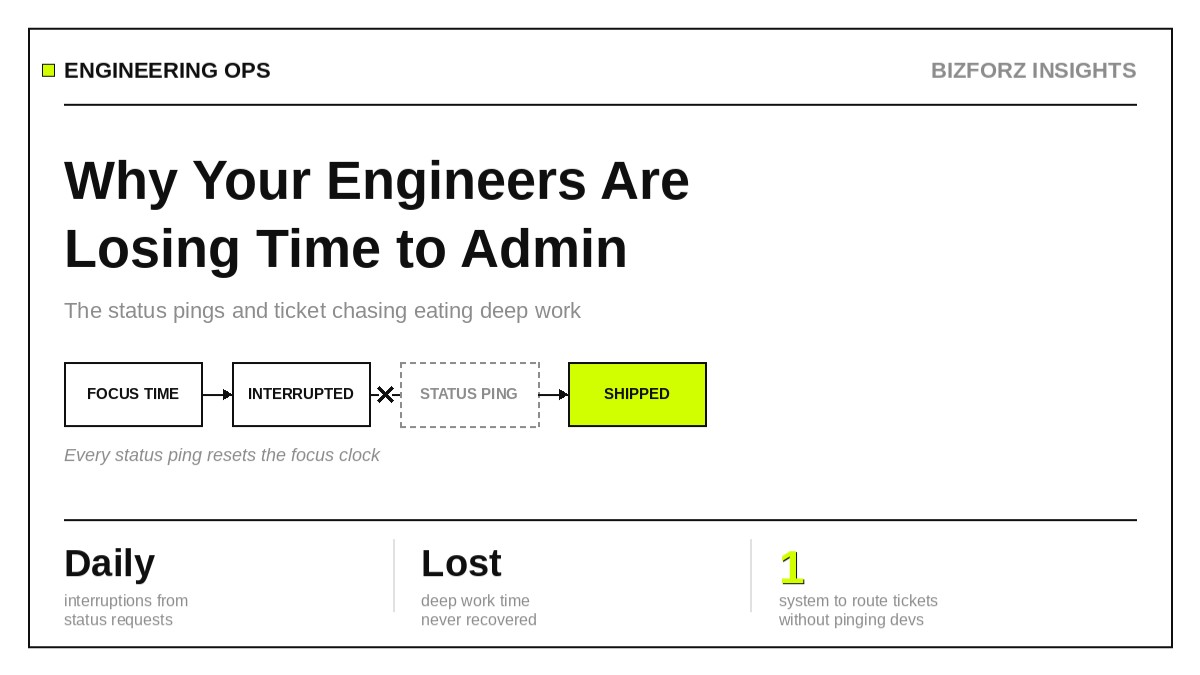
Walk into most engineering teams and ask why a sprint slipped, and you'll rarely hear “the code was hard.” You'll hear about the bug report that came in through three different channels before anyone owns it, the daily “any update on this?” messages from account managers, and the hour lost every time someone has to stop, explain where a ticket stands, and then rebuild the mental context they had before the interruption. None of that shows up in a sprint retro as “admin overhead.” It shows up as “we didn't move as fast as expected,” and everyone quietly accepts that as normal.
The cost of an interruption isn't the two minutes it takes to answer a question — it's the fifteen to twenty minutes it takes to get back into deep focus afterwards. Engineers doing complex work hold a lot of context in their heads: the part of the codebase they're in, the edge case they were tracing, the next three steps they'd planned. A single “where are we on this?” message doesn't just cost the time to reply; it costs the rebuild. Multiply that by every support ticket that lands directly in a developer's inbox instead of a queue, and engineering capacity quietly bleeds out without anyone writing it down as a loss.
Most of this isn't a discipline problem — it's a visibility problem. When the only way to know if a bug is being worked on is to ask the engineer directly, asking becomes the default behaviour for everyone, all day. The fix isn't training people to interrupt less; it's making status visible without anyone needing to interrupt at all. This is exactly the gap Bizforz Ticket is built to close: every issue gets logged, assigned, and tracked with a visible status, so a support lead or account manager can check where things stand without ever pinging the engineer directly — the update exists in the system instead of in someone's head.
The same problem doesn't stop at software bugs either. Teams that sell or support physical equipment deal with an entirely separate stream of interruptions — a client calling about a faulty device, a field issue that needs a technician dispatched, a hardware replacement that needs approval — and these requests almost always arrive through whichever channel is most convenient for the client, not the team.
Bizforz Ticket's client support module is built to absorb all of it in one place: software bugs, customer queries, and hardware or field-service requests all become trackable tickets with an owner and a status, instead of being split across email threads, phone notes, and a developer's inbox. The engineer only gets pulled in when a ticket is actually theirs to solve — not every time someone needs to know where things stand.
Protecting engineering time isn't about working engineers harder — it's about removing the hundred small interruptions standing between them and the work they were hired to do. A team