
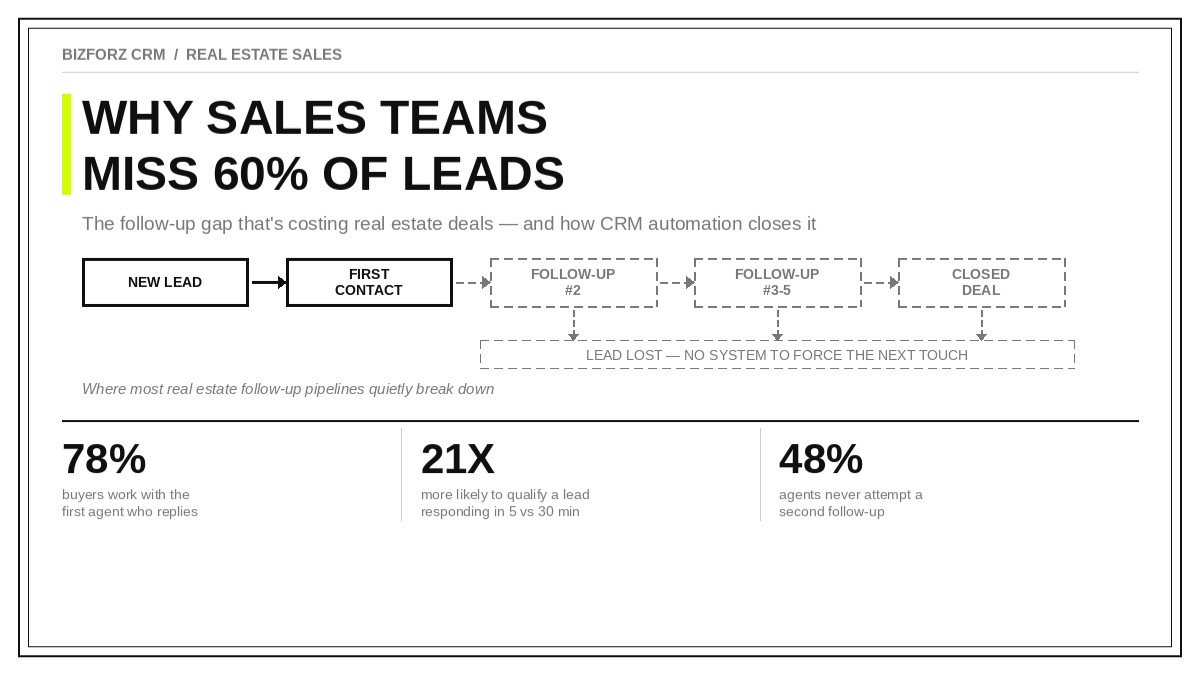
Speed is the most underpriced variable in real estate sales. Research from MIT and InsideSales, built on more than a million tracked sales leads, found that agents who respond within five minutes are 21 times more likely to qualify a prospect than those who wait even thirty. NAR's own buyer research backs this up from the other side: the majority of buyers work with the first agent who responds to them, and most never seriously interview a second. Every hour a lead sits untouched isn't a neutral delay — it's active erosion. The prospect is still searching, still messaging other agents, still forming a first impression of who takes them seriously. Teams that treat response time as a soft metric are quietly handing deals to whoever built faster infrastructure.
The instinct is to blame the agent. It's rarely fair. Industry follow-up data show that roughly 80% of sales close between the fifth and twelfth contact, yet nearly half of agents never attempt a second follow-up at all. That's not laziness — it's what happens when follow-up depends entirely on a human being remembering to act, in the middle of showings, closings, and three other live deals. A star performer with a spreadsheet and a good memory can outperform this system for a while. A growing team cannot. The moment lead volume outpaces any one person's working memory, follow-up becomes probabilistic instead of guaranteed, and probabilistic follow-up is exactly where the 60% goes missing.
The break rarely happens at first contact — most teams are decent at answering the phone or replying to the first inquiry. It happens at contact two, three, and four, where there's no system forcing the next touch to happen. After-hours leads are the clearest example: a large share of inquiries arrive in the evening or on weekends, when the buyer is browsing after work, and these are consistently the slowest to get any reply at all. By the time an agent circles back the next afternoon, the lead has already been contacted by someone else or has simply gone quiet. Multiply that gap across every new inquiry, every week, across an entire team, and the compounding loss is what shows up as a stalled pipeline at the end of the quarter — even when top-of-funnel lead generation looks healthy.
A contact list with reminders isn't a fix — it still relies on an agent opening it, reading it, and acting on it every single day. The gap only closes when follow-up stops being a task and becomes infrastructure. This is the specific differentiator behind Bizforz CRM: the moment a lead is captured, it's automatically queued into a multi-touch follow-up sequence across call, text, and email, so the sixth contact attempt fires whether or not the agent remembers it's due. Every touchpoint is logged against the lead automatically, so managers can see exactly where in the sequence a deal is sitting, instead of trusting individual notebooks and memory. That single shift — from follow-up as a personal habit to follow-up as a system default — is the difference between a team that loses leads to slow replies and one that turns response speed into a repeatable advantage.
Fixing the follow-up gap doesn't require more leads, more ad spend, or more headcount — it requires making sure the leads already being paid for don't silently disappear. A team converting even a modest share of its currently-missed leads changes its numbers more than most marketing initiatives ever will, because the cost of acquisition on those leads is already sunk. The teams that will win the next five years of real estate aren't the ones generating the most inquiries. They're the ones with infrastructure ambitious enough to make sure every inquiry gets the eighth call, not just the first. Bizforz CRM is built for exactly that shift — from reactive follow-up to automated, ambitious pipeline management that doesn't depend on anyone's memory.