
Every distribution business grows the same way: one region becomes five, five dealers become fifty, and a single WhatsApp group becomes an unmanageable archive of order confirmations, credit notes, and stock photos. Distribution networks in India, in particular, are built on tiers — super-stockists, regional distributors, retailers — and each tier adds a layer of opacity. What worked at 10 dealers, a spreadsheet updated once a week, breaks completely at 100. Leadership stops knowing what's actually moving in the field, and by the time a stockout or a payment default shows up in a report, it's already cost a sales cycle.
The damage isn't abstract. It shows up as duplicate orders placed because no one could see what a dealer already had in stock. It shows up as incentive schemes paid out on guesswork because no one tracked sell-through at the dealer level, only sell-in from the distributor. It shows up as regional managers flying blind into review meetings, unable to say with confidence which dealers are growing, which are stagnant, and which are quietly switching to a competitor. None of this is a sales problem — it's an infrastructure problem, and it compounds every quarter the network keeps growing without a system underneath it.
Most CRMs are built for a flat list of B2B contacts moving through a single pipeline. Distributor networks need something structurally different: a system that understands hierarchy. That means dealer master records tagged by tier, region, and territory owner; order and fulfilment tracking that ties back to each dealer's account; live inventory-at-dealer visibility instead of inventory-at-warehouse guesses; scheme and incentive tracking tied to actual performance; and a communication log that survives when the sales rep who owned that relationship moves on. Bolting this onto a generic sales tool usually fails — the hierarchy has to be native to how the CRM is built, not retrofitted with custom fields.
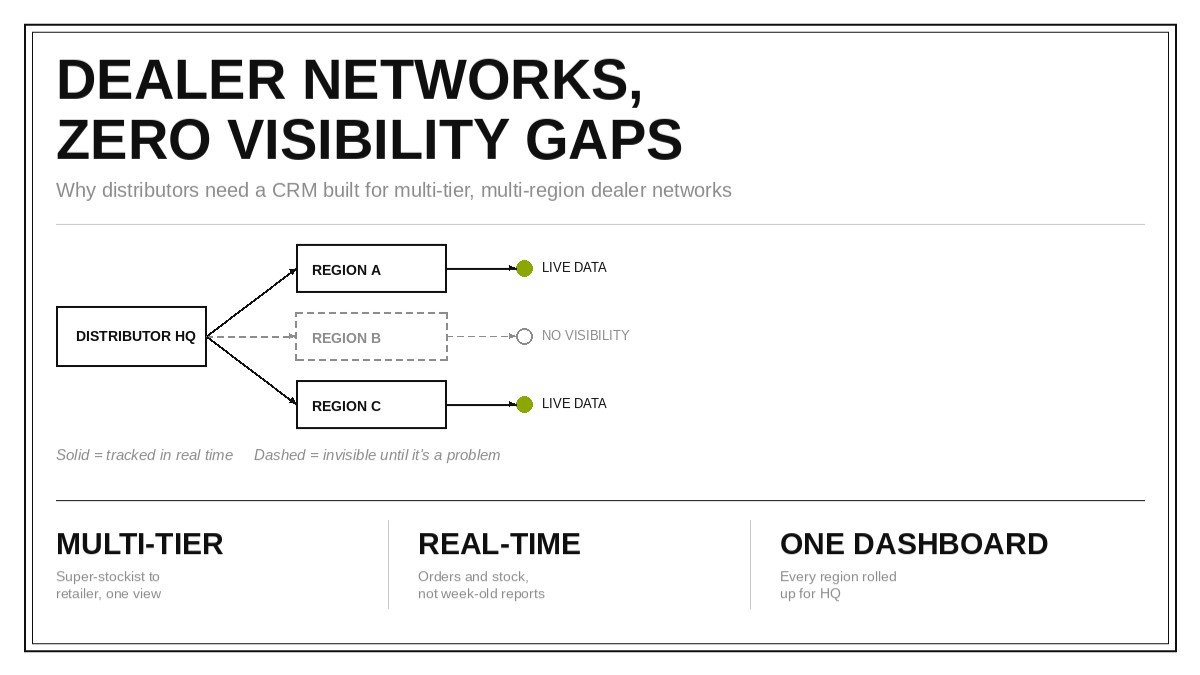
The distributors who get this right treat access control as a feature, not an afterthought. A regional manager should see their territory and nothing else. A dealer, if given portal access, should see only their own orders and stock position. Headquarters should see the full roll-up — every region, every tier, live — without waiting for someone to consolidate spreadsheets at month-end. This is where most CRMs built for flat sales teams fall apart: they either expose too much to too many people, or they force IT to build custom permission logic for every new region the business enters.
Bizforz CRM approaches this differently by starting from the same problem systems integrators face — managing multiple linked entities under one account, each with its own status and history — and applying that same multi-entity structure to dealer networks. Instead of treating every dealer as an isolated contact, Bizforz CRM lets a distributor model tiers, territories, and roll-up reporting natively, so a regional manager's dashboard and a headquarters dashboard pull from the same live data, filtered by hierarchy rather than duplicated across spreadsheets. That's the concrete difference: visibility that scales with the network instead of degrading as it grows.
As distribution networks expand across states and increasingly across borders, the businesses that win won't be the ones with the most dealers — they'll be the ones who can actually see all of them, in real time, without a war room of spreadsheets. Visibility into a dealer network isn't a reporting nicety; it's the operating system the rest of the business runs on. Distributors still managing that visibility manually aren't just working harder than they need to — they're flying a growing fleet with a map that's already out of date.