
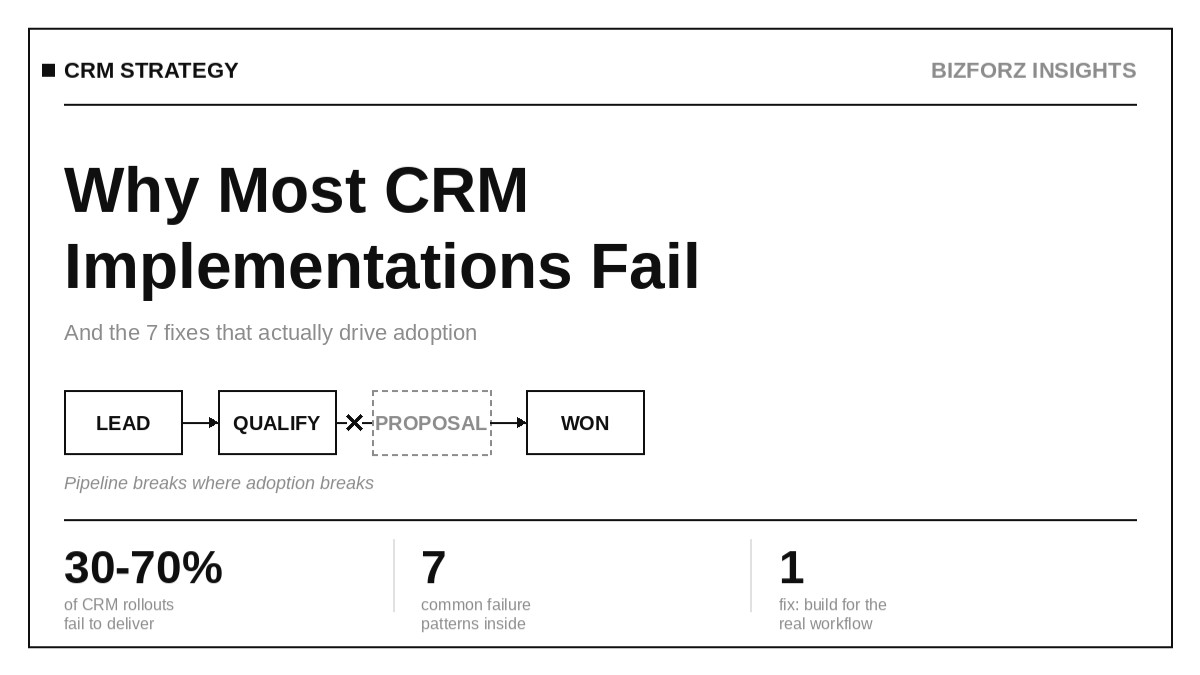
Most CRM implementations fail not because the software is weak, but because organisations skip clear objectives, executive ownership, and user adoption planning. Industry research puts failure rates between 18% and 70%, with people and process issues — not technology — responsible for over 75% of breakdowns. Fixing CRM failure starts with treating it as a business change, not an IT install.
Why do most CRM implementations fail? Most CRM implementations fail because companies treat them as a technology purchase rather than a business transformation. The software gets installed correctly, but the people, processes, and goals around it are never aligned, so the system never gets used the way it was meant to.
A widely cited CRM Failure Report, which defines failure as not achieving the implementation's originally planned business objectives, puts the modern enterprise CRM failure rate at 55%.
Harvard Business Review reviewed 12 separate analyst studies and found reported failure rates ranging from 18% to 69% — and when executives were specifically asked whether their CRM was actually helping the business grow, that number jumped closer to 90%, according to the same analysis summarized by Johnny Grow's CRM research.
What is the real CRM failure rate, and why do the numbers vary so much? The CRM failure rate varies because there's no single industry definition of “failure.” Depending on whether researchers measure missed objectives, budget overruns, abandoned rollouts, or low usage post-launch, reported rates range from roughly 18% to 80%.
Other widely referenced figures include Gartner's 50% failure rate and Forbes' estimate of 55–75%, both cited in AnneomalyDigital's analysis of CRM failure research. A separate breakdown from Vantage Point's People-Process-Technology framework puts the figure at roughly 70%, attributing it primarily to low user adoption (38%), inadequate change management (22%), and poor data quality (18%) — together, people and process issues account for over 75% of CRM failures, while only 6–10% trace back to the software itself. The takeaway across every study: regardless of the exact percentage, technology is rarely the bottleneck. People and process are.
Why does low user adoption sink so many CRM projects? Low user adoption is the single biggest driver of CRM failure because a CRM only works if the sales and support teams actually log activity into it. If the interface is clunky, slow, or disconnected from how reps actually sell, teams quietly revert to spreadsheets and inboxes within weeks.
According to the Vantage Point People-Process-Technology framework, low user adoption alone accounts for 38% of CRM failures — more than any other single cause. Separately, research summarised by Arjan KC's root-cause analysis found that features built for end-users are roughly four times more likely to be cut during implementation than management-reporting features — meaning the people expected to use the CRM daily are often the last priority when scope gets trimmed. This is where AI-forward CRMs like Bizforz CRM make a structural difference: when the system auto-logs calls and emails, drafts follow-ups, and surfaces next-best actions instead of demanding manual data entry, adoption stops being a training problem and becomes the path of least resistance.
Why does weak executive sponsorship kill CRM rollouts? Without a visible, accountable executive owner, a CRM rollout has no authority to enforce new workflows, resolve cross-department conflicts, or prioritise budget for training and integration. The project drifts to IT or a project manager who can install software but can't mandate behaviour change. Executive sponsorship isn't a kickoff-meeting appearance — it's ongoing involvement in defining success metrics, reviewing adoption dashboards monthly, and publicly holding teams accountable to using the system as the system of record.
Why does bad data undermine CRM success? A CRM populated with duplicate records, outdated contacts, and inconsistent formatting becomes unreliable within months, so sales and support teams stop trusting it — and once they stop trusting it, they stop using it. Garbage data compounds because every new record inherits the same lack of standards. Poor data quality is cited as a top-three failure driver across multiple studies, including the Vantage Point framework (18% of failures) and Clevyr's implementation analysis, which flags both poor data integrity and failure to integrate the CRM with other business systems as recurring causes of siloed, distrusted data.
Why do businesses pick the wrong CRM in the first place? Many teams choose a CRM based on brand recognition or a sales demo rather than how closely it maps to their actual sales process, team size, and technical capacity. An enterprise platform built for thousand-person sales orgs is often the wrong fit — and the wrong amount of complexity — for a 20-person team that needs something it can configure and adopt in days, not quarters.
How can a business avoid becoming part of the CRM failure statistic? Businesses that succeed with CRM treat the rollout as a structured business initiative with an owner, a budget for change management, and a 90-day adoption plan — not a one-time software purchase. The highest-leverage fixes map directly to the top causes of failure: • Define 3–5 measurable business objectives before evaluating vendors (e.g., reduce lead response time, increase pipeline visibility) • Assign a named executive owner accountable for adoption, not just procurement • Pick a CRM that matches your actual sales process and team size — not the most feature-dense option • Clean and standardise data before migration, not after • Budget for role-based training and a 30/60/90-day adoption review, not just a go-live date The payoff for getting this right is significant: a Nucleus Research CRM ROI study found companies earn $8.71 for every dollar spent on a well-implemented CRM.