
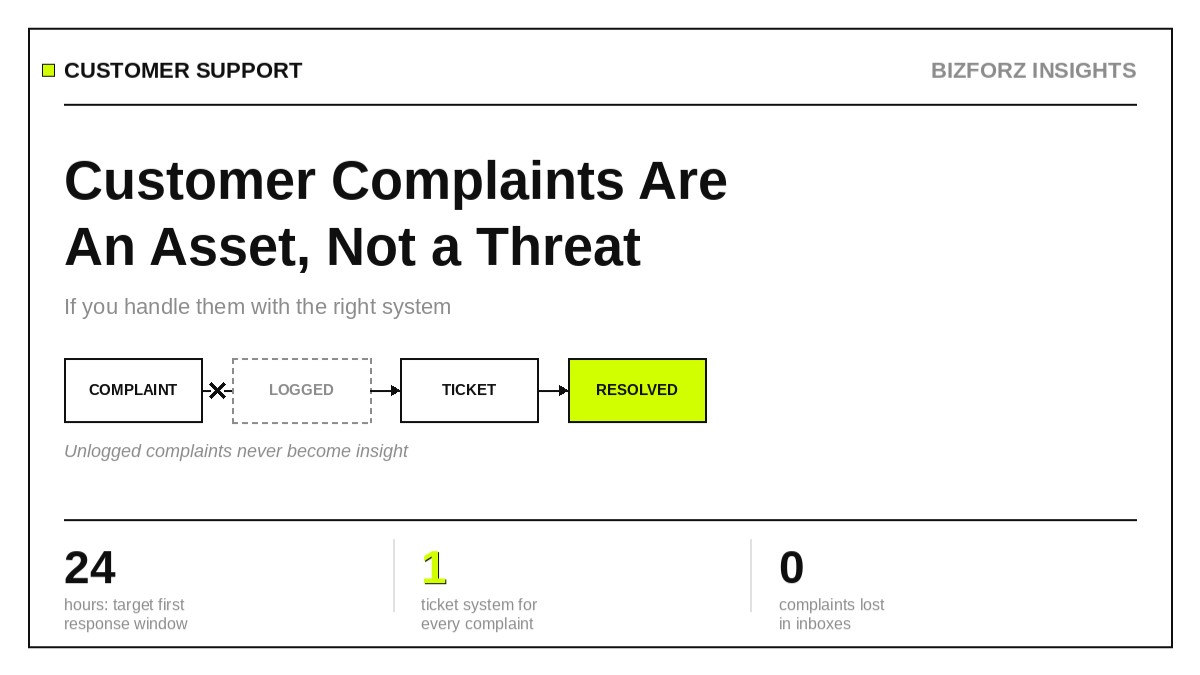
Most businesses treat a complaint as a fire to put out, not as information. That instinct is understandable but backwards. A customer who complains is still talking to you — they haven't churned yet, they haven't left a one-star review yet, they're giving you one more chance to fix something before they go elsewhere. The businesses that grow fastest aren't the ones that receive the fewest complaints; they're the ones that treat every complaint as a data point worth capturing, not noise worth ignoring.
The problem is rarely intended — it's infrastructure. A complaint that comes in through email, another through a phone call, another through a WhatsApp message and a fourth from a sales rep who heard about it in passing has no chance of being tracked consistently. Each channel becomes its own silo, each complaint depends on someone remembering to follow up, and patterns that would be obvious in one place stay invisible when scattered across five inboxes. By the time a complaint resurfaces as a churn statistic, nobody can say how many times it was raised before that.
A single point of capture changes the entire equation. This is exactly what Bizforz Ticket is built around: every complaint, regardless of channel, becomes a ticket with an owner, a status, and a resolution clock — so nothing depends on memory and nothing gets quietly dropped between departments. The differentiator isn't just logging the complaint; it's that the same ticket data rolls up into patterns — the same issue raised by twelve customers in a month is a product problem, not twelve unrelated annoyances, and a system that tracks tickets centrally is what makes that pattern visible in the first place.
Speed of resolution matters as much as the system itself. A complaint acknowledged within hours signals that the business is paying attention; a complaint that sits unanswered for a week signals the opposite, regardless of how it's eventually resolved. Setting a clear first-response target — and holding the team accountable to it through visible ticket status, not goodwill — is what turns a complaint-handling process from reactive firefighting into a predictable, repeatable part of how the business runs.
Complaints will keep coming regardless of how good the product gets — that's not a failure, it's customers still engaging. What separates businesses that turn that into loyalty from those that bleed customers quietly is whether there's a system underneath catching every single one.