
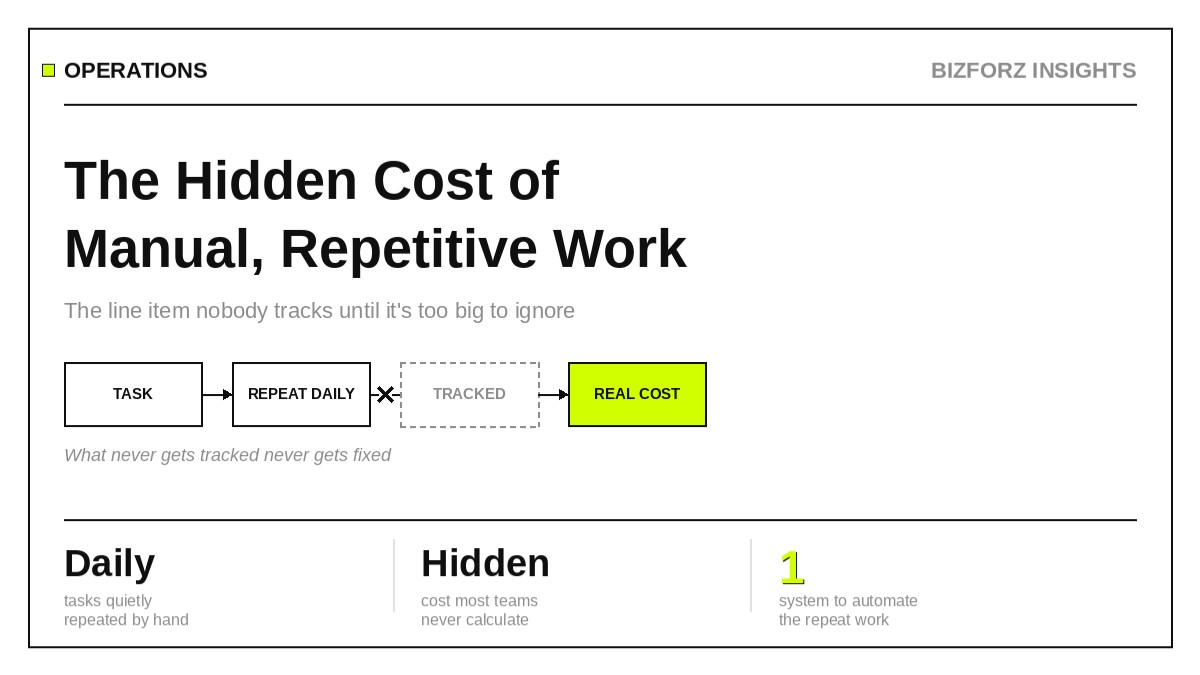
Ask any business owner where their money goes, and they'll point to payroll, rent, software, and marketing spend — line items with numbers attached. Almost nobody points to the hours their team spends manually copying data between spreadsheets, chasing approvals over WhatsApp, or re-entering the same customer details into three different systems. That cost is real, it's often larger than people assume, and it never shows up on a balance sheet because nobody assigned it a line item in the first place. Untracked costs don't get fixed — they get normalised.
The real damage isn't just time — it's where that time comes from. Manual work doesn't get assigned to whoever has the least to do; it gets absorbed by whoever's closest to the process, which is often a manager, a founder, or a senior employee whose time is the most expensive in the building. Every hour a team lead spends manually compiling a weekly report or chasing field staff for status updates is an hour not spent on the judgment calls only they can make. The cost compounds because the work that gets crowded out is usually the highest-value work in the company.
Manual processes also fail quietly. A typo in a spreadsheet, a missed step in an approval chain, a status update that never reached the right person — none of these triggers an alarm. They surface weeks later as a missed deadline, an unhappy customer, or a number that doesn't reconcile, by which point nobody remembers exactly where it went wrong. Automated, system-driven processes fail loudly and immediately — a rule doesn't fire, a notification doesn't go out — which makes them far easier to catch and fix than a human who quietly forgot a step in a process that exists only in their head.
This is precisely the problem Bizforz Flow is built to solve — not by digitising a task in isolation, but by turning the operational processes that run on memory, spreadsheets, and chat messages into structured workflows with visible status, ownership, and accountability at every step. The differentiator isn't automation for its own sake; it's that a manager can see exactly where every recurring process stands at any moment, instead of asking five people for an update and hoping the answers match.
The honest exercise every business should run is simple: list the five tasks your team repeats every single week, and ask who's actually doing them. If the answer is your most capable people, manually, with no record of what happened or why — that's not a minor inefficiency. That's the most expensive line item in the business, and it's the one nobody's tracking.