
Most coaches who go online make the same mistake: they treat the move as a content project instead of a relationship project. They record their best material, upload it to a course platform, and assume the coaching has been preserved because the knowledge has been preserved. It hasn't. Clients didn't pay for information — they could get that from a book or a search engine. They paid for someone who noticed when they were stuck, pushed back when they made excuses, and adjusted the plan when life got in the way. A video library can't do any of that.
The drop-off numbers on self-paced courses tell the real story. Clients sign up motivated, watch the first few modules, and then quietly stop — not because the content was bad, but because nobody noticed they'd gone quiet. In an in-person coaching relationship, that silence would have triggered a phone call. Online, it usually triggers nothing at all until the client cancels. The human touch isn't a nice-to-have layered on top of the content; it's the mechanism that catches people before they disengage.
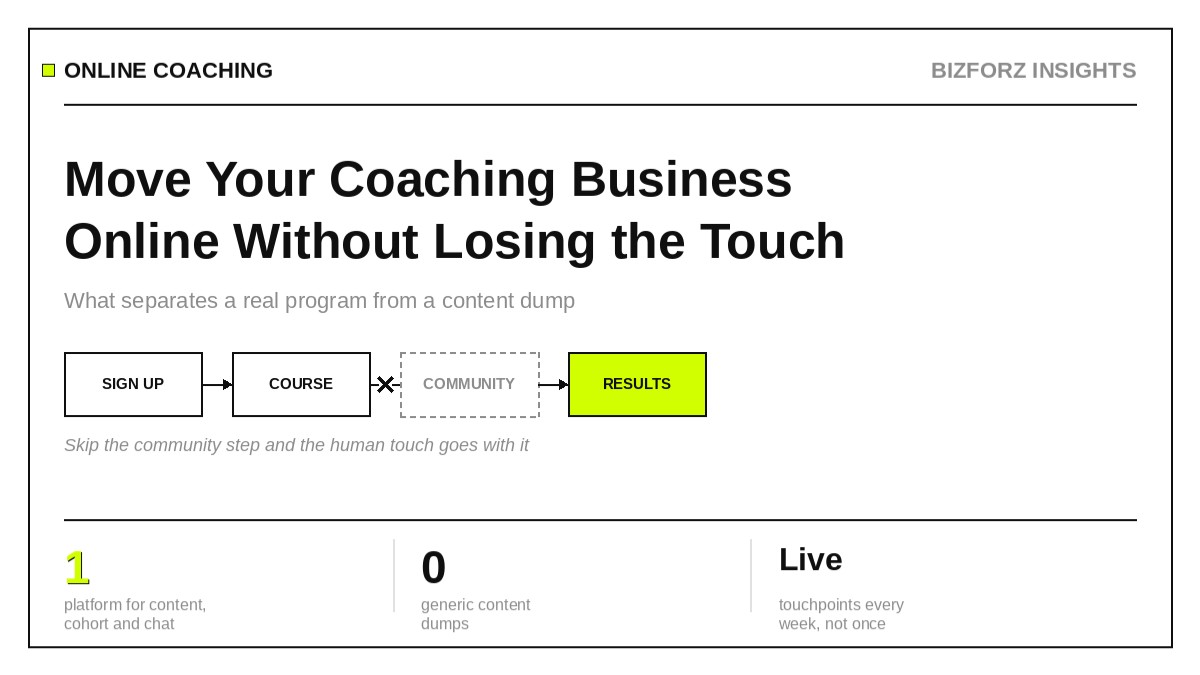
The coaches who scale successfully build the relationship back into the structure instead of hoping it survives the transition. That means a cohort starts together instead of everyone learning in isolation, a weekly live call or office hours where the coach is actually present, and a community space where clients can be seen struggling or succeeding in real time. This is the gap Bizforz LMS is built to close: it's not a video hosting tool with a course wrapped around it — content, cohort scheduling, and community discussion all live in the same place, so a coach can see exactly who's falling behind and reach out before they disappear, instead of finding out when the refund request comes in.
Going online was never supposed to mean going distant. The coaches who get this right don't ask “how do I package my knowledge into videos” — they ask “how do I make sure every client still feels like someone's watching their progress.” Build the system around that question, and the human touch survives the move. Ignore it, and the business becomes a content library with a subscription fee attached.