
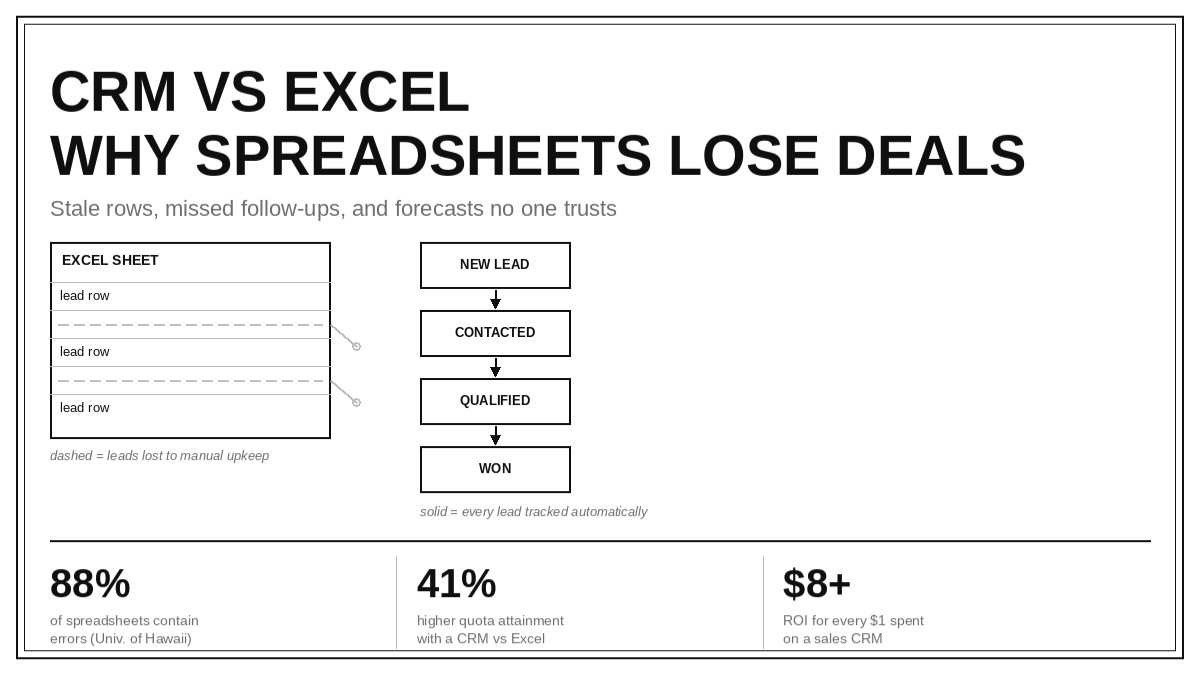
Spreadsheets cost sales teams deals because they don't update in real time, can't automate follow-ups, and rely on manual entry, which is error-prone by design. Research shows 88% of spreadsheets contain errors, and CRM-using teams report 41% higher quota attainment than spreadsheet-based teams. A CRM replaces guesswork with a live, shared system of record.
Why are spreadsheets still costing sales teams deals? Spreadsheets cost deals because they were built for calculation, not relationship management. They have no concept of follow-up reminders, deal stages, or shared real-time visibility, so leads quietly go cold while reps assume someone else is handling them.
Sales reps are also stretched thin to begin with: Salesforce's State of Sales report found that reps spend only 40% of their time actively selling, with the rest lost to admin, internal meetings, and manual data entry — the exact overhead a spreadsheet-based process adds rather than removes.
Why does manual data entry cause so many costly errors? Manual entry causes errors because every cell, formula, and update depends on a human typing it correctly the first time, with no built-in validation. A single mistyped number or overwritten formula can silently distort a forecast for weeks before anyone notices.
A long-running body of research from the University of Hawaii's spreadsheet error studies, led by Professor Ray Panko, found that 88% of spreadsheets contain errors once audited. Separately, Forrester Consulting research cited by Isard found that 37% of businesses lose revenue directly due to inaccurate data.
Why do deals slip through the cracks without a shared system of record? Deals slip through the cracks because spreadsheets have no concept of ownership or notification — if a rep forgets to update a row, no one else is alerted that a follow-up is overdue. Multiple versions of the same file circulating by email only multiply the risk. By contrast, a shared pipeline view means a manager can see a stalled deal the moment it stalls, not three weeks later during a forecast call.
Why does CRM adoption actually improve quota attainment? CRM adoption improves quota attainment because it automates the follow-ups and reminders that spreadsheets leave to memory, and it gives reps a prioritised view of what to do next instead of a static list of rows. Less time spent searching and updating means more time spent selling.
According to research summarised by Teamgate's CRM forecasting analysis, companies using CRM tools report up to 41% higher sales quota attainment compared to teams relying on spreadsheets, and businesses see over $8 in ROI for every $1 spent on a sales CRM.
This is precisely where Bizforz CRM is built to outperform a spreadsheet: it auto-logs every call and email against the right deal, flags stalled deals before they go cold, and gives managers a live pipeline view — none of which a static grid of cells can ever do, no matter how many formulas are layered on top.
When should a sales team move off Excel and onto a CRM? A team has outgrown Excel when more than one person edits the pipeline, leads are coming in faster than they can be manually tracked, or a manager can no longer trust the numbers in a forecast without double-checking them row by row. At that point, the spreadsheet is actively working against the team, not for it. • More than one rep or manager touches the same pipeline file • Lead volume exceeds what can be reliably logged by hand each day • Forecast meetings start with reconciling conflicting numbers • Follow-ups are missed because no one “owns” the reminder